Prevention and screening
Pap smear or HPV test: which cervical screening is right?
Cervical cancer is one of the few cancers that can almost always be prevented. Here is how the Pap smear and HPV test work, when to start, and what a result means.
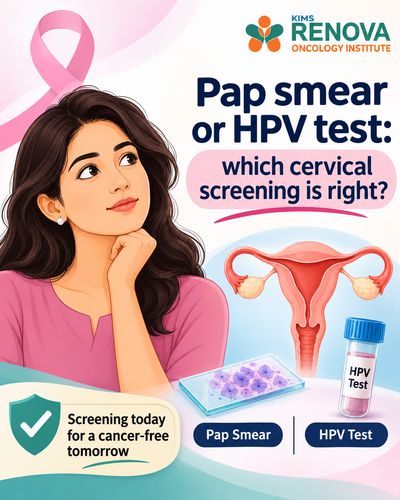
Many women in India have never had a cervical check, and the reasons are familiar. “I have no problems, so why test?” “It will be painful.” “What will people at home think?” Some women simply don’t know the test exists.
Yet cervical cancer is one of the very few cancers that can usually be prevented altogether. Cervical cancer screening finds early changes in the cervix (the neck of the womb) years before they could turn into cancer, when treatment is simple. This article explains the two main tests, when to start, and what your result means.
Screening is for women who feel perfectly well. That’s the whole point of it.
Why cervical cancer can be prevented
Almost all cervical cancers are caused by long-lasting infection with certain types of HPV (human papillomavirus), a very common virus passed on through sexual contact. Most HPV infections clear up on their own. In a small number of women, the virus stays for years and slowly changes the cells of the cervix.
These early cell changes are not cancer. They take many years to develop, and they can be found and treated in a short clinic procedure. That long, slow path is what makes screening so effective.
The World Health Organization has set a goal for every country to eliminate cervical cancer as a public health problem. Its targets for 2030 are for 90% of girls to be fully vaccinated against HPV by age 15, 70% of women to be screened with a high-performance test by ages 35 and 45, and 90% of women with pre-cancer or cancer to receive treatment.
Pap smear and HPV test: what’s the difference?
The Pap smear (also called a Pap test) looks at cells collected from the cervix under a microscope, to see whether any of them look abnormal.
The HPV test checks the same kind of sample for the high-risk types of HPV that can cause cancer. Because it finds the cause rather than the changes, it picks up risk earlier. WHO now recommends HPV testing as the preferred screening test.
VIA (visual inspection with acetic acid) is a simple test in which a health worker applies dilute vinegar to the cervix and looks for colour changes. It’s widely used in government screening programmes in India, especially where laboratories aren’t easily available.
All three are useful. The best test for you depends on your age, where you are being tested, and what’s available. Your doctor will advise you.
When to start cervical cancer screening, and how often
WHO’s current advice for most women is:
- From age 30, screening with an HPV test every 5 to 10 years
- Women living with HIV: from age 25, every 3 to 5 years
Where only Pap smears are available, they’re usually repeated more often, about every 3 years. Your doctor will tell you when your next test is due based on your result.
You can usually stop screening in later life if your recent results have been normal. Ask your doctor before stopping.
What happens on the day of the test
It’s a short outpatient test, usually done by a gynaecologist or a trained nurse.
-
Timing: book it for a day when you’re not having your period.
-
Before the test: for a day or two, avoid vaginal creams, douching and intercourse, as these can affect the sample.
-
During the test: you lie on an examination table and a smooth instrument called a speculum is gently placed in the vagina, so the cervix can be seen. A small soft brush collects some cells. This takes a few minutes. Most women feel pressure or mild discomfort, not pain.
-
After the test: you can go home and carry on normally. A little spotting is possible.
-
Results: usually ready within one to two weeks, depending on the laboratory.
A note on self-sampling. In some places, women can collect their own sample for an HPV test using a simple swab, in private. Ask whether this is available near you.
What does an abnormal result mean?
An abnormal result is common, and it almost never means cancer. It usually means one of two things:
- HPV was found. This tells you the virus is present, not that you have cancer. You may be asked to have a further check, or a repeat test after some time.
- Some cells look abnormal. These are usually early changes that can be watched or treated.
The next step is often a colposcopy, in which the doctor looks at the cervix through a magnifying instrument and may take a small biopsy. If pre-cancerous changes are found, they can usually be removed in a short procedure in the clinic.
A common misunderstanding: “I’ve had the vaccine, so I don’t need screening”
The HPV vaccine is excellent protection, and WHO recommends it mainly for girls aged 9 to 14, before they become sexually active. But the vaccine doesn’t cover every cancer-causing type of HPV. Vaccinated women still need regular screening when they reach screening age.
When to see a doctor
Screening is for women without symptoms. If you have any of these, don’t wait for a screening test. See a doctor soon:
- Bleeding after intercourse
- Bleeding between periods
- Any bleeding after menopause
- A foul-smelling or blood-stained vaginal discharge
- Pain in the lower abdomen or during intercourse that doesn’t go away
The Gynaecological cancers page explains these symptoms in more detail.
Frequently asked questions
Is a Pap smear painful?
Most women feel mild discomfort or pressure for a minute or two, not pain. Telling the doctor or nurse you’re nervous helps them go slowly. If it hurts, you can ask them to stop.
I’m not married. Do I need screening?
Screening depends on whether you have ever been sexually active, not on marriage. If you have, follow the same advice on when to start. If you’re unsure, a doctor can advise you privately.
Can a normal result mean I’ll never get cervical cancer?
A normal result means your risk is very low for the next several years, which is why the next test can wait. It doesn’t protect you for life, so keep up with your regular tests.
Does a positive HPV test mean my partner has been unfaithful?
No. HPV is extremely common and can stay silent in the body for many years. A positive result says nothing about when or from whom the infection came.
Book a check-up
If you’re due for screening, or have had an abnormal result and want to understand what comes next, you can book a consultation with Dr. Suraga Belakawadi at KIMS RENOVA Oncology Institute, Mahadevpura, Bengaluru.
Related reading
- Gynaecological cancers and HIPEC
- Understanding over fear: key insights on early cancer detection and prevention
References
- World Health Organization. Cervical cancer (fact sheet), 2026. who.int
- World Health Organization. WHO guideline for screening and treatment of cervical pre-cancer lesions for cervical cancer prevention, 2nd edition, 2021. who.int
- World Health Organization. Global strategy to accelerate the elimination of cervical cancer as a public health problem, 2020. who.int
- US National Cancer Institute. Cervical Cancer Screening (Pap and HPV testing). cancer.gov
- American Cancer Society. Screening Tests for Cervical Cancer. cancer.org
This article is general information to help you understand a condition. It is not a diagnosis or a substitute for a consultation. See the medical disclaimer.
More on prevention and screening
Exercise as Cancer Prevention: The Science Behind Movement
Can Exercise Actually Prevent Cancer? 🏃♂️🛡️ The answer is a scientifically-backed YES. Many people view exercise only as a tool for weight loss, but it is…

Understanding Over Fear: Dr. Suraga Belakawadi Shares Key Insights on Early Cancer Detection and Prevention
Dr. Suraga Belakawadi shares essential insights in Praja Pragathi on moving past the fear of cancer through awareness, timely screening, and healthy habits. Learn how recognizing early warning signs and seeking expert medical evaluation can save lives.
The Biology of Inflammation: Why It Matters and How Lifestyle Can Turn It Down
Inflammation is often misunderstood. 🛑 It’s often blamed for everything—from cancer to heart disease. But the truth is more nuanced. Inflammation is not the…